
Pushback on the PostgreSQL vs. MySQL comparison
It should come as no surprise that not everybody agrees with EnterpriseDB’s views on the PostgreSQL/MySQL comparison. In particular, the High Availability MySQL blog offers a detailed rebuttal post, with more in the comment thread. According to MySQL fans, EnterpriseDB got its facts wrong on several matters regarding MySQL and InnoDB, especially in the areas of triggers and locking. And of course they disagree with EnterpriseDB’s general conclusion. 🙂
| Categories: MySQL, Open source, PostgreSQL | Leave a Comment |
How is MySQL’s join performance these days?
In a comment thread on a recent post comparing MySQL to Postgres, Jonathon Moore chimed in based on experience with both products. His characterization of some MySQL problems: Read more
| Categories: Infobright, MySQL, Open source | 8 Comments |
Google has thousands of internal data formats, mostly simple ones
In connection with the release of Protocol Buffers, Kenton Varda of Google wrote: Read more
| Categories: Data integration and middleware, Google | 2 Comments |
Another Cognos scandal in Massachusetts
I already posted about the Boston Globe’s reporting on a deal to supply the whole Massachusetts state government with Cognos software that since has been investigated and rescinded.
The Globe now reports that a multimillion dollar deal the prior year with the Massachusetts Department of Education was equally dubious. Lowlights include: Read more
| Categories: Business intelligence, Cognos | Leave a Comment |
EnterpriseDB’s itemized claims of Oracle compatibility
Obviously, I’m poking around EnterpriseDB’s site this morning (in connection with their status as my client, actually). Anyhow, we all know that one of EnterpriseDB’s core claims is great Oracle-compatibility — but what exactly do they mean by that? I found a fairly clearly laid-out answer, as of last year, in this white paper and and — even more simply — in this blog post summarizing the white paper.
PostgreSQL vs. MySQL, as per EnterpriseDB
EnterpriseDB put out a white paper arguing for the superiority of PostgreSQL over MySQL, even without EnterpriseDB’s own Postgres Plus extensions. Highlights of EnterpriseDB’s opinion include:
- EnterpriseDB asserts that MyISAM is the only MySQL storage engine with decent performance.
- EnterpriseDB then bashes MyISAM for all sorts of well-deserved reasons, especially ACID-noncompliance.
- EnterpriseDB asserts that row-level triggers, lacking in MySQL but present in PostgreSQL, are the most important kind of trigger.
- EnterpriseDB claims PostgreSQL is superior in procedural language support to MySQL.
- EnterpriseDB claims PostgreSQL is superior in authentication support to MySQL.
| Categories: EnterpriseDB and Postgres Plus, Mid-range, MySQL, Open source, PostgreSQL | 17 Comments |
Declaration of Data Independence (humor)
The data warehouse appliance industry has a well-developed funny bone. Dataupia’s contribution is a Declaration of Data Independence, which begins:
When in the Course of an increasingly competitive global economy it becomes necessary for one data set to dissolve its connections to a constraining environment, the separate but inherently unequal station to which the Laws of Whose budget is larger prevails.
Related links:
- Cartoons from DATAllegro
- April Fool press release from Netezza
Three cartoons from DATAllegro
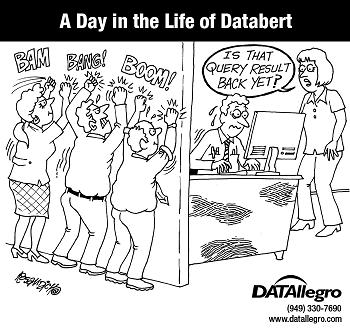
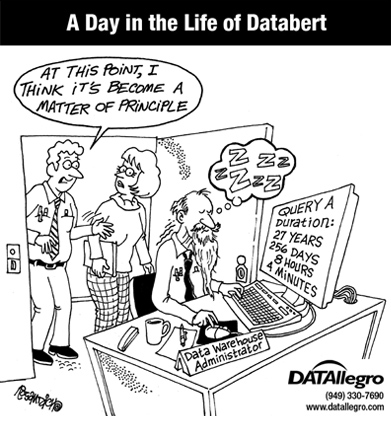
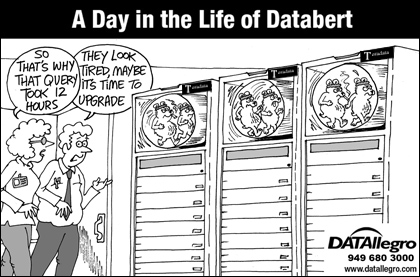
Related links:
- Humor from Netezza
- Another gerbil-based solution
| Categories: Analytic technologies, Data warehousing, DATAllegro, Humor | 1 Comment |
Event processing vs. data-driven processing
Marco Seiriö offers a distinction between event processing and data-driven processing. Specifically, he says that if an event has an ID, then it’s true event processing; if it doesn’t, and what you’re doing looks somewhat like event processing anyway, then you’re doing data-driven processing. Read more
The IRS data warehouse
According to a recent Eric Lai Computerworld story and a 2006 Sybase.com success story,
- The IRS has a data warehouse running on Sybase IQ, with 500 named users, called the CDW (Compliance Data Warehouse). (Computerworld)
- By some metric, it’s a 150 TB warehouse. (Computerworld)
- By some metric, they add 15-20 TB/year, with a 4 hour load time. (Computerworld)
- As of 2006, there were 20-25 TB of “input data”, with a “70% compression rate”. (Sybase)
I can’t entirely reconcile those numbers, but in any case the database sounds plenty big.
Computerworld also said:
the research division also uses Microsoft Corp.’s SQL Server to store all of the metadata for the data warehouse and the rest of the agency. Managing and cleaning all of that metadata — 10,000 labels for 150 databases — is a huge task in itself,
| Categories: Analytic technologies, Data warehousing, Specific users, Sybase | 2 Comments |